Rewriting the rules of fit in Europe: 3 key takeaways from CPHFW AW26
Rewriting the rules of fit in Europe: 3 key takeaways from CPHFW AW26
Zalando joined Copenhagen Fashion Week’s official talk program, with Vogue Business as media partner, to dig into one of fashion’s biggest frustrations: finding the right fit online.
Zalando joined Copenhagen Fashion Week’s official talk program, with Vogue Business as media partner, to dig into one of fashion’s biggest frustrations: finding the right fit online.

Moderated by Amy O’Brien (Tech Editor, Vogue Business), the panel brought together Pelin Anli Bedirhanoglu (Director of Product Management, Zalando), Leona De Graft (VP Ecommerce, Levi’s), and Dr. Helena Lewis-Smith (Body Image & Psychology Consultant). Together, they explored how new tech masters personalised fit, transforms high returns into design insights, and ensures psychological comfort for customers.
Here are three takeaways that defined the conversation.
1. The 2026 reality check: why previous tech failed
The panel opened by addressing a hard truth: virtual try-on technology is not new, but for years, it struggled to move past being a "fun" gimmick. Pelin Anli Bedirhanoglu pinpointed the root of the problem: the sheer complexity of the human form.

"If you think about the sizing problem, you have billions of bodies and none of them have the exact same shape. And they are ever changing. On the other hand, you have billions of pieces of clothing in various shapes and forms. We are constantly trying to match the two to each other and hope for a perfect fit, both physically, but also digitally. Creating the representation of this fit for these billions of moving pieces is extremely challenging." — Pelin Anli Bedirhanoglu
Pelin highlighted that Zalando’s journey has been about steady, data-driven progress rather than a "magic" fix. Since 2023, small-scale pilots with selected brands, including Levi’s, have shown significant return rate reductions (up to 40% in the jeans category), giving Zalando the confidence to launch the virtual fitting room experience at a larger scale for all customers in 2026.
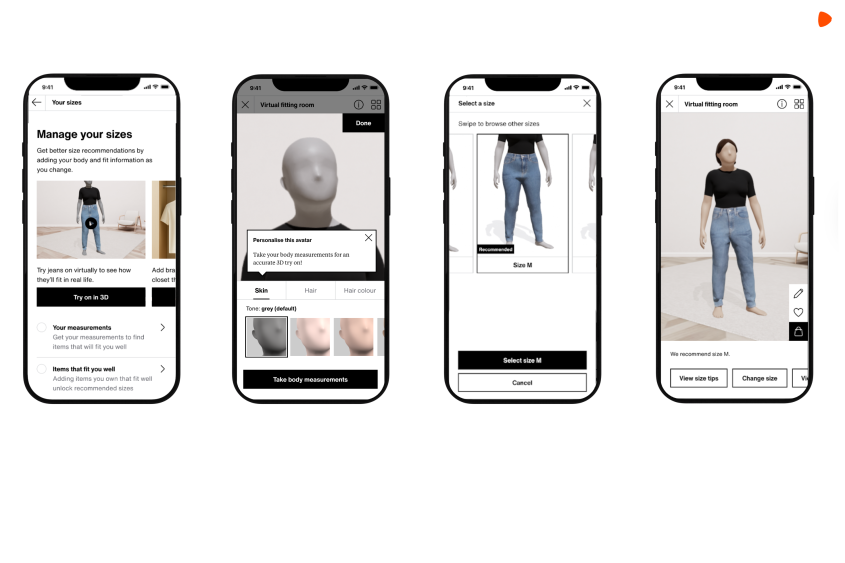
For brands like Levi’s, the success of this technology depends on moving away from static images toward interactive digital tools:

"We piloted the virtual fitting room with Zalando using renders of our products and saw strong results. We’re also leaning into ratings and reviews because you still want to see what a product looks like on a body. Marrying that technology with that personal touch is working; Our efforts to build a strong digital foundation have enabled us to accelerate our e-commerce business. We’ve just announced our ecommerce business grew 22% globally in the last quarter." — Leona De Graft
2. Psychological safety: would you really want to shop with a digital twin?
As the technology matures, a harder question follows: how does it make people feel? Dr. Helena Lewis-Smith warned that a hyper-realistic "mirror" isn't always empowering for a customer.

"When people see an image of themselves, they naturally make comparisons. If they perceive a discrepancy between themselves and what they’re seeing, such as feeling that a digital self looks better than the actual self, this can lead to body shame, anxiety, and dissatisfaction with their bodies. These responses could be amplified when individuals are confronted with a full-body representation. We want to move away from experiences that elicit body dissatisfaction." — Dr. Helena Lewis-Smith
Zalando’s own experiments confirmed this: "Nobody wants to see their naked avatar with a precise body shape," Pelin admitted. Consequently, the focus for 2026 has shifted to "Psychological safety." The goal is to dial the technology so it remains functional and helpful for size advice without triggering negative feelings.

The "Style" factor: why math isn't everything
The final piece of the puzzle is acknowledging that "fit" is often a mix of data and personal preference. Leona De Graft explained that for a brand like Levi’s, "fit" is often a moving target dictated by personal preference and cultural trends.
"Fit is deeply personal, as are jeans: Two people with similar measurements can want very different fits. Size recommendations that don’t account for individual preferences will always feel incomplete. For example. this summer where we were selling 'jorts,' and consumers were buying much bigger sizes to style a really baggy look. It was just the way they were styling the product. Data is key, but personal styling also plays a really crucial role in how we’re recommending size and fit." — Leona De Graft

This is where technology and brand expertise intersect. Reviews, customer photos, styling cues, and movement all help customers imagine how a product will feel on their body — not an abstract one. To close, Helena reminded the industry that the technology is ultimately a tool for confidence:
"We want to be harnessing fashion for good and helping people feel empowered and confident. This means focusing on how clothing supports embodiment, self-expression, and identity, rather than emphasizing fit in ways that may encourage objectification and its associated negative effects." — Dr. Helena Lewis-Smith
The outlook: is standardisation dead?
The conversation concluded with a consensus that the industry must move beyond the search for a universal size chart. As Pelin put it:
"Standardisation is not the answer. Back in the tailoring days, we didn't have this problem because everything started with the body. Tech is finally helping us get back there, building the bridge between the customer’s unique body and the brand." — Pelin Anli Bedirhanoglu
At Zalando, we believe the next chapter of fit starts with transparency. By replacing the sizing "guessing game" with clearer, more consistent product data, we’re helping our customers shop with true confidence.
Zalando SE Boiler Plate EN
About Zalando
Founded in Berlin in 2008, Zalando is the leading European technology platform for fashion and lifestyle. The Zalando group connects 62 million active customers with more than 7,000 brands across 29 markets. Our business is built on a unique AI-powered data and infrastructure platform. For our customers, our multi-app approach - comprising Zalando, ABOUT YOU, and Lounge by Zalando - delivers an inspiring, highly personalized shopping experience, serving different customers with different needs. For our partners, we are building the operating system for e-commerce. Through ZEOS, Tradebyte, and SCAYLE, we open our logistics, software, and service capabilities to brands and retailers, enabling them to seamlessly scale their businesses across borders.
For further information, please visit: corporate.zalando.com/en
Contact Corporate Communications
Corporate Communications
press@zalando.com