How Zalando approaches AI-powered content: accuracy, customer value and human judgement
How Zalando approaches AI-powered content: accuracy, customer value and human judgement

- AI is changing how Zalando produces content, helping us improve the customer experience. It enables teams to respond faster to trends, adapt content for local markets and build richer product experiences at scale.
- The product itself remains accurately represented. Technology can change the setting, format or way an item is presented, but it doesn’t change the product customers are deciding whether to buy.
- The goal is to help customers make confident choices, not simply create more content. The same quality bar applies regardless of the tool, with clear checks and human judgement helping ensure content is useful, accurate and does not create misleading expectations.
Fashion e-commerce is entering a new phase of content production: faster, more scalable and increasingly shaped by AI. But as the technology becomes more embedded, a harder question comes into focus: how do you gain speed and scale without losing sight of the real product customers are buying? As new EU transparency rules for AI-generated content take effect, we sat down with Matthias Haase, VP Content Solutions at Zalando, to discuss what AI is changing for customers, how Zalando keeps the real product at the centre, and why human judgement remains essential.
AI now supports a growing share of Zalando’s content production. What has actually changed for customers?

For us, AI is ultimately a production tool – like Photoshop, editing software or other post-production technologies. The starting point is not the tool itself, but what customers expect from the experience.
One expectation is relevance in the moment. Fashion trends can emerge almost overnight, and AI-supported workflows help us move from production cycles of six to eight weeks to just a few days, with the ambition to respond to relevant cultural moments in under 24 hours. It also makes localisation easier – adapting content to what feels relevant in a specific market, whether that is Riviera dressing in France, Oktoberfest in Bavaria or another local cultural moment. We can see that customers enjoy and interact more with this content, finding it more relevant and helpful for their fashion choices. On average, AI content created in response to emerging trends drives a strong uplift in add-to-wishlist, increases in add-to-cart, and more brand follows.
The second expectation is richer product information. A simple product image on a white background is still important, but it is no longer enough on its own. Customers want to understand how a product looks in context, how the material moves and what it looks like from different angles. Richer imagery, video and 3D help answer those questions. Elevated content drives around 10% higher engagement, while customers who view product videos are three times more likely to buy and also return fewer items.
So the real change is not that we can generate more content. It is that we can be more relevant when customers are discovering and more informative when they are deciding what to buy.

What makes AI-powered content high quality and accurate?
For us, the quality bar stays the same, no matter which tool we use. AI can change how quickly we create or adapt an asset, but it should not change what customers can expect from the product they see.
The product itself is non-negotiable. Its colour, shape, proportions, texture and key details stay true. Technology can help us change the setting or format around a real product, but the point is not to simulate a better version of the item or create an expectation the physical product cannot meet.
The hard part is maintaining that accuracy at scale. Generative models are designed to create plausible images, which means that when the source information is incomplete, they can sometimes infer details that are not actually there – a seam, a texture or even a pocket. Those changes can be subtle and still look convincing, which is why we need to assess the output against the real product, not simply whether the image looks good.
There is a very practical reason for that: we want to help customers make confident choices and reduce unnecessary returns, not create more of them. No one benefits if an image looks great but the product disappoints when it arrives. For us, high quality means content that is visually strong and useful while remaining true to what the customer is actually buying.

What does meaningful transparency look like when AI can be used in so many different ways?
AI can be used in very different ways, so transparency must be designed with nuance rather than a blanket approach. Using technology to adapt the setting around a real product is not the same as generating synthetic content designed to deceive someone about what is real.
As EU AI Act transparency requirements take effect, we are carefully assessing their application across distinct use cases, recognizing that the appropriate measure depends entirely on the nature, context, and potential risk of the content. Where mandatory, we fully comply. However, effective disclosure must distinguish between invisible technical marking and visible labels.
Visible labels are reserved specifically for scenarios where content could otherwise mislead consumers or mimic reality without clear context. Over-labeling routine or harmless enhancements creates unnecessary visual noise, undermines user experience, and causes "label fatigue" – ultimately eroding consumer trust rather than building it.
For us, the underlying principle is simple: technology should help customers understand and discover products, not create the wrong impression of what they are buying. The tools will continue to evolve, but keeping the real product at the centre should not.
As more of the production process becomes automated, how do you make sure that standard holds?
As we create content at greater scale, quality control needs to become part of the workflow itself. We’ve learned that relying on the human eye alone to catch subtle AI-generated deviations is not scalable. And as the models become better at creating convincing images, some inaccuracies can become harder to spot.
That is why we are building a “product truth” engine into our production pipeline. It acts as an AI-powered quality assurance layer, automatically comparing generated content with the original product imagery and checking details such as colour, construction and brand marks. If something looks wrong or a product detail has been altered, the asset is flagged for correction.
This means technology can take on more of the repetitive quality checks, while our creative teams focus on the areas where human judgement matters most: whether the content is on-brand, relevant, stylish and right for the customer. For us, scaling AI only makes sense if we can scale quality and accuracy with it.
Where does human creative judgement remain essential?
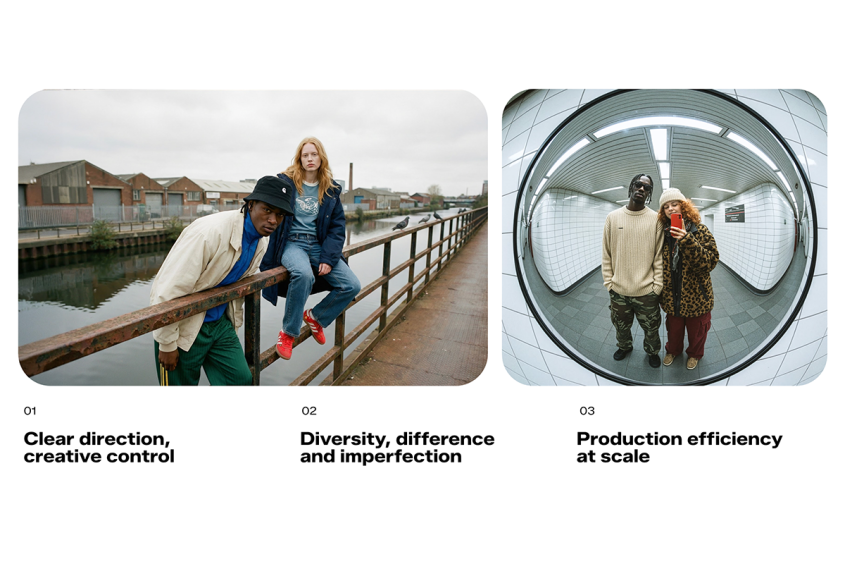
At both ends of the process: deciding what we want to create and deciding whether the result meets our quality standards.
Our stylists, art directors and production teams shape the creative direction – from which trends and cultural moments are worth responding to, to how a brand should be represented and what feels relevant for a particular market.
Human judgement is just as important when assessing the output. Something can be technically correct and still feel generic, off-brand or wrong for the context. Fashion is visual, cultural and emotional; not everything that matters can be reduced to a production rule.
So as AI takes on more of the execution, the role of creative teams does not disappear but changes. It shifts towards the decisions where fashion expertise, context and taste matter most.